
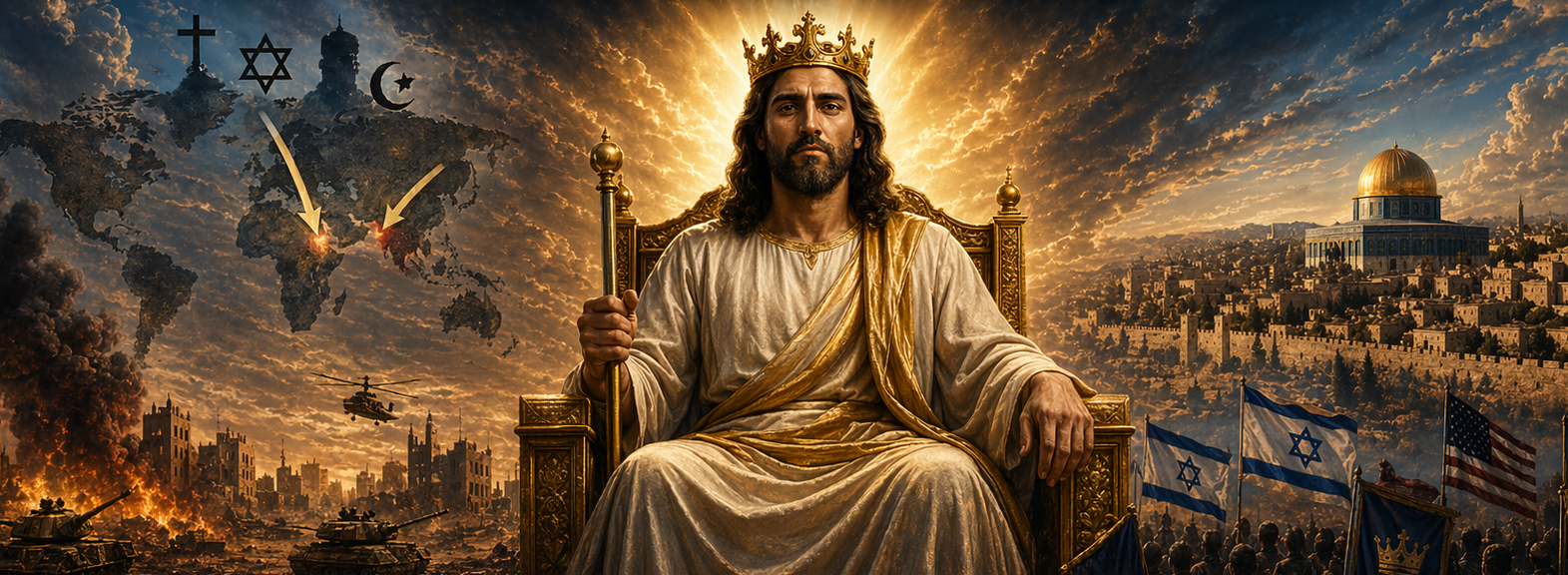
We are living in an age in which prophecy, politics, and geopolitics are increasingly being woven together in the public imagination. Wars are not merely seen as wars. Sacred sites are not merely seen as sacred sites. National conflicts are not merely read as political struggles. More and more, they are interpreted through apocalyptic expectation.
Out of this atmosphere has emerged a new phrase: the law of eschatological convergence.
By this is meant the idea that different religious and ideological end-time expectations, though contradictory in doctrine, can still move nations, movements, and political actors toward the same contested spaces, crisis points, and anticipated outcomes. In simple terms, rival prophetic visions may still converge in practice.
At one level, this observation contains a measure of practical truth. What people believe about the future often shapes how they behave in the present. End-time narratives can influence alliances, fears, territorial claims, political commitments, and even military attitudes.
History is not governed by converging apocalyptic expectations. History is governed by the sovereign reign of Jesus Christ.
That is the central issue. The nations do not determine the future. Ideologies do not determine the future. Religious zeal does not determine the future. Christ does, He is not waiting to become Lord, He is Lord. He is not waiting to inherit authority; He has been given all authority in heaven and on earth. Therefore, the final outcome of history does not belong to those who most aggressively interpret prophecy, but to the enthroned Son of God.
The future is not in the hands of competing prophetic systems, but in the hands of the reigning Christ.
A Modern Theory Is Not a Biblical Law
The first theological clarification that must be made is this: the so-called law of eschatological convergence is not biblical.
At best, it may function as a modern sociological observation. It may describe how rival future-oriented beliefs sometimes produce overlapping political behaviour. But it is not a revealed doctrine. It is not a covenantal reality. It is not a principle given to the Church by Christ or His apostles.
The danger is subtle. A phrase begins as a description, then slowly becomes an explanation. Explanation then hardens into a framework. The framework then begins to rival revelation. Before long, people start treating a recent analytical label as though it explains history with prophetic authority.
The Church must resist that drift. We do not interpret the future through fashionable terminology. We interpret the future through the self-revelation of God in Christ and through the witness of Holy Scripture. A modern phrase may help describe a pattern, but it cannot become a governing hermeneutic for the people of God.
When Eschatology Becomes Speculation Rather Than Revelation
There is no doubt that beliefs about the future affect conduct in the present. That is true pastorally, spiritually, and politically. A people shaped by fear will act one way. A people shaped by hope will act differently. A people governed by panic will become reactive. A people governed by Christ’s present reign will be stable, discerning, and faithful.
This is why eschatology matters so deeply. False eschatology produces distorted discipleship. It can train believers to expect collapse rather than maturity, retreat rather than witness, and crisis rather than consummation. It can make the Church interpret every treaty as a sign, every war as a timetable, every sanctuary as a trigger, and every rumour as a prophetic code.
That is not apostolic maturity; that is prophetic instability. The Kingdom of God does not call the Church to sensationalism; it calls the Church to sobriety, endurance, discernment, and faithful witness in the midst of history. We are not called to become consumers of escalation in turmoil and wars. We are called to become ambassadors of the peace of the reigning Christ.
Any eschatology that feeds panic will eventually weaken witness.
The Kingdom Perspective: The End Is Consummation, Not Chaos
One of the great errors in much modern apocalyptic thinking is that it imagines the end primarily in terms of catastrophe. The imagination of many believers has been formed more by collapse than by consummation. But biblically, the end is not merely termination, it is fulfilment and maturity. It is completion and the bringing of God’s purpose to its appointed goal.
The end is not God abandoning history; the end is God bringing history to consummation in Christ. That distinction is decisive and absolute.
If the Church believes the future is mainly about collapse, its posture will become defensive and fearful. If the Church understands that the future is about the triumph of Christ and the consummation of His purpose, its posture will become faithful, courageous, and fruitful.
A Kingdom reading of eschatology, therefore, refuses to surrender the future to panic. The final word over history is not chaos; the final word is Christ. The final word is not disintegration, the final word is consummation.
Christian Zionism and the Danger of Eschatological Activism
This discussion becomes especially significant when we consider Christian Zionism. Christian Zionism is not merely a positive regard for Jewish people. Nor is it simply the political affirmation that the modern state of Israel has a right to exist. In many of its forms, it is a theological system that binds modern Israel, the land, prophecy, and the second coming into a particular end-time sequence. Support for Israel then becomes more than political sympathy; it becomes participation in an expected prophetic process.
This is precisely where the idea of eschatological convergence becomes relevant. Different groups, with different theologies and different ultimate hopes, may still converge around the same land, the same sacred geography, the same temple expectations, and the same crisis zones. Their doctrines are not identical, yet their actions may intensify the same theatre of conflict.
That is why great caution is required. The Church must refuse any theology that allows modern geopolitics to govern biblical interpretation. Once headlines become our hermeneutic tools, we have already surrendered apostolic ground. Scripture must judge the age; the age must never be allowed to judge Scripture.
The Church must also distinguish carefully between biblical Israel, post-biblical Judaism, the modern secular nation-state of Israel, and the eschatological fulfilment of God’s promises in Christ. These are not identical categories. To collapse them into one undifferentiated whole is theological carelessness.
Kingdom scholars must therefore reject both antisemitism and uncritical Zionist absolutism. We reject hatred of the Jewish people entirely. We also reject any prophetic system that effectively sacralises a modern nation-state beyond moral or theological scrutiny. Christ alone occupies that place of ultimacy.
The Church must not exchange Christ-centred theology for geo-religious obsession.
Paul’s Understanding of Judaism in Romans
Any discussion of Israel, Zion, or Jewish identity must be tested against the apostle Paul’s argument in the book of Romans. Paul writes with profound grief, reverence, and theological seriousness concerning Israel. He honours Israel’s historical privileges. He acknowledges the covenants, the law, the promises, the patriarchs, and above all, the coming of the Messiah according to the flesh. Paul does not erase Israel’s significance, nor does he demean Jewish history. He does not speak of Israel with Gentile arrogance.
But neither does he grant covenantal security apart from Christ. This is where Romans becomes decisive. Paul insists that not all who are descended from Israel are Israel. With that statement, he moves the matter beyond ethnicity, lineage, and natural descent into the deeper realm of promise, calling, and the purpose of God. He further argues that outward covenant markers are not sufficient in themselves. Circumcision without the inward reality of redemption cannot secure righteousness. Possession of the law without obedience to Christ cannot justify anyone. Historical privilege without faith cannot save. Paul brings Jew and Gentile alike under the same verdict: all are under sin, and righteousness is revealed in Christ for all who believe. That is the heart of the matter.
Paul does not offer one redemptive path for Jews and another for Gentiles. He does not construct a Christless covenantal future for Israel. He does not allow zeal, ancestry, or historical role to replace the necessity of the Messiah. His entire argument presses toward the righteousness of God revealed in Jesus Christ.
When Paul says that Christ is the telos of the law, he is not marginalising Israel. He is locating Israel’s true fulfilment. Christ is not external to Jewish hope. He is its climax, fulfilment, and goal.
This protects us from two opposite errors. One is contemptuous supersessionism, which dismisses the Jewish people with arrogance. Paul forbids that spirit. The other is Zionist absolutism, which treats Jewish identity or the modern Israeli state as though it operates in a covenantal category untouched by Christ. Paul forbids that as well.
Romans gives us a framework that is tender, sober, and uncompromising: honour Israel’s place in redemptive history, reject Gentile arrogance, reject antisemitism, but insist that the hope of Israel, like the hope of the nations, is fulfilled only in Jesus Christ.
The Church Must Not Become an Agent of Prophetic Escalation
There is a grave danger in all speculative end-time systems: they can tempt people to become agents of acceleration. When believers assume that certain crises must occur, they may begin to welcome escalation. They may legitimise conflict and treat destruction as necessary. They may sanctify geopolitical tension because they believe it advances prophecy. This is profoundly dangerous.
The Church is not called to engineer chaos in order to assist fulfilment. We are not called to inflame history. We are not called to help fulfil prophecy. We are called to obey Christ, preach the gospel, embody holiness, do justice, endure faithfully, and bear witness to the Kingdom of God within history. Any eschatology that begins to delight in destruction has already departed from the Spirit of Christ.
The Church must recover a thoroughly Christ-centred eschatology.
- Christ reigns now.
- Christ is subduing His enemies now.
- Christ is building His Church now.
- Christ is governing history now.
- And Christ will appear in glory to consummate what He already inaugurated through His death, resurrection, ascension, and enthronement.
This gives the Church stability. We do not have to be naïve about the political development of the nations. We do not have to ignore the power of religious narratives in world affairs. We do not have to pretend that prophetic belief has no geopolitical consequences. But neither do we bow before speculative systems, geo-religious obsessions, or activist apocalypticism. We maintain that the future belongs to Christ and His glorious kingdom.
Therefore, the Church must be alert, but not alarmist; discerning, but not sensational; informed, but not ruled by headlines. Our task is to embody our standing as the people of God, to function within the present age as a royal priesthood, a holy nation, and an apostolic people under the government of Jesus Christ. The Church is not called to predict the future into being, but to bear witness to the King who already reigns over it.
Conclusion
The so-called law of eschatological convergence may describe, at a limited sociological level, how rival end-time beliefs can shape overlapping political behaviour around the same geopolitical theatres. But it is not a biblical law, not an apostolic doctrine, and not a reliable theological compass. The Church must not interpret history through converging apocalyptic scripts. The Church must interpret history through the reign of Christ.
And when the question of Israel, Judaism, Zionism, and the nations arises, the apostolic standard remains clear: we reject antisemitism, we reject religious arrogance, we reject Christless nationalism, and we insist that the purpose of God for Jew and Gentile alike is fulfilled only in the Messiah, Jesus Christ.
The end of history is not ultimately about the escalation of terror and global destabilisation; it is about the consummation of God’s eternal purposes.
The end is not panic.
The end is not prophetic chaos.
The end is not the triumph of ideology.
The end is the public unveiling of the victory, reign, and consummated Kingdom of Jesus Christ, the Lord.