WRITTEN SUBMISSION
to the Portfolio Committee on Cooperative Governance and Traditional Affairs
Concerning the CRL Rights Commission and Matters Affecting Religious Communities in South Africa
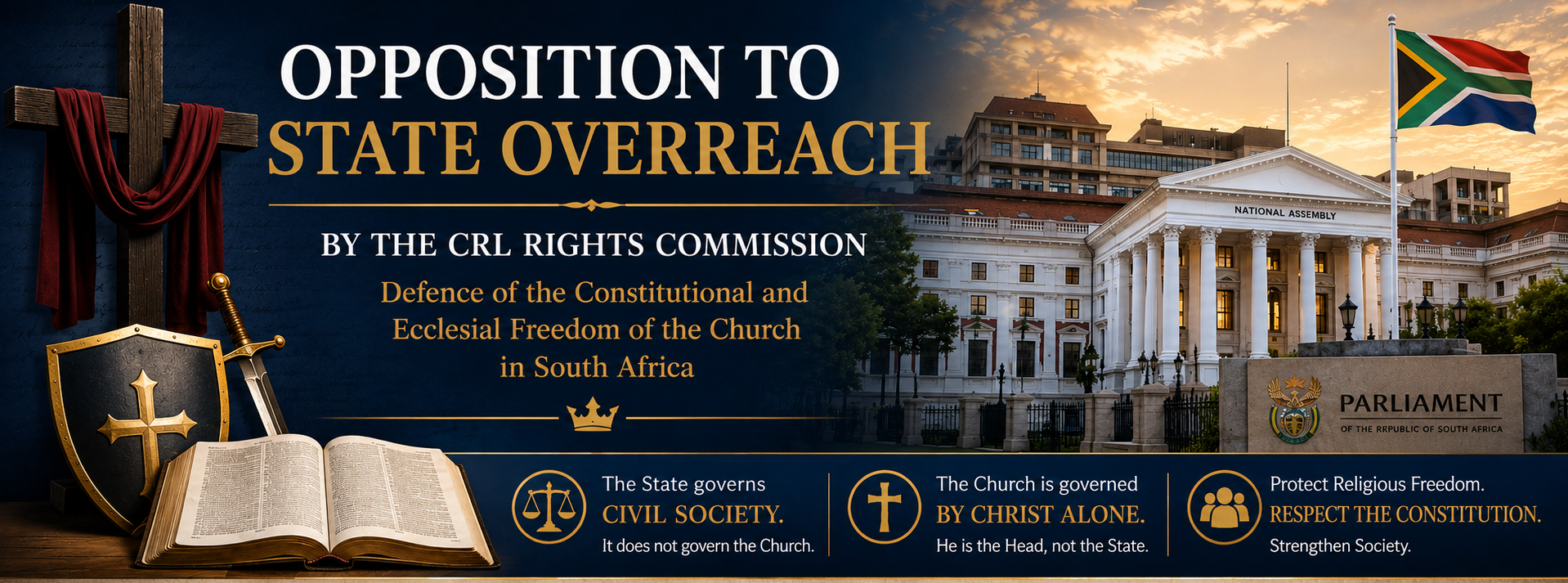
Opposition to State Overreach by the CRL Rights Commission and Defence of the Constitutional and Ecclesial Freedom of the Church in South Africa
Submitted by
Dr Vincent G. Valentyn
Date of Submission
28 May 2026
Submitted in defence of religious freedom, constitutional restraint, and the ecclesial autonomy of the Church under the Lordship of Jesus Christ.
- Introduction
I respectfully submit this paper to the Portfolio Committee on Cooperative Governance and Traditional Affairs in response to the invitation for written submissions concerning the conduct, mandate, and current direction of the CRL Rights Commission in relation to religious communities in South Africa.
This submission is made in a spirit of constitutional respect, civic responsibility, and deep concern for the future of religious freedom in our nation. It is not submitted in defence of abuse, exploitation, manipulation, financial misconduct, or criminal behaviour committed under the banner of religion. Such conduct must be condemned unequivocally and addressed through the lawful mechanisms already available within the South African constitutional and criminal justice framework.
However, this submission strongly opposes any attempt by the CRL Rights Commission, or any organ of the State, to govern, regulate, supervise, license, certify, control, or administratively determine the doctrine, worship, ordination, spiritual authority, internal discipline, governance structures, or ecclesial life of the Church of Jesus Christ.
The fundamental position of this submission is clear: the State has legitimate authority within civil society, public order, criminal justice, administrative justice, and the protection of constitutional rights. However, the State does not have legitimate authority to govern the Church. The Church of Jesus Christ is not created by the State, authorised by the State, constituted by the State, or spiritually accountable to the State. The Church exists under the Headship and Lordship of Jesus Christ.
The State may regulate conduct in society. It may prosecute crime. It may enforce financial, labour, zoning, child protection, and civil laws and obligations. It may act where any person or institution violates the rights of another. But the State may not cross the constitutional and spiritual boundary into the government of faith, doctrine, conscience, ordination, worship, ecclesial leadership, or spiritual legitimacy.
- The Core Issue Before the Portfolio Committee
The real issue before the Portfolio Committee is not whether abuse in religious settings should be addressed; it must be addressed. The real issue is whether the CRL Rights Commission’s current approach risks creating a mechanism through which the State may indirectly regulate religion, particularly the Christian Church.
There is an important distinction between protecting people from unlawful conduct and governing the religious community itself.
The Church is not asking for immunity from the law. Churches, pastors, bishops, apostles, prophets, elders, ministers, trustees, and members remain subject to the laws of the Republic of South Africa in all matters of civil conduct. If fraud is committed, the law must act. If an assault is committed, the law must act. If sexual abuse is committed, the law must act. If money laundering, tax evasion, child abuse, labour exploitation, or public endangerment occurs, the law must act. But these matters already fall within existing legal frameworks.
The danger arises when specific abuses are used to justify a broad religious regulatory architecture that begins to classify, approve, discipline, register, legitimise, or delegitimise churches and spiritual leaders as religious actors. That would move beyond civil law enforcement and into ecclesial control and manipulation.
Such a move would constitute an unacceptable breach of religious freedom, freedom of association, freedom of conscience, and the autonomy of religious communities.
- The Church Is Governed by Christ, Not by the State
The Church of Jesus Christ is a spiritual, covenantal, and ecclesial body governed by Christ as Head. Its authority is not derived from Parliament, a commission, a court, a department, a regulatory council, or an administrative committee. Its authority is derived from Christ Himself.
The Christian confession is that Jesus Christ is Lord. This is not merely a private devotional claim; it is the foundational constitutional reality of the Church. The Church’s doctrine, worship, sacraments, ordination, discipline, mission, and internal governance arise from Scripture, the Lordship of Christ, the ministry of Holy Spirit, and the historic continuity of Christian faith and apostolic practice.
Civil government does not create the Church and therefore cannot govern the Church in her essential nature; it is beyond its scope and divinely appointed powers.
The State may recognise religious communities as part of civil society, but recognition is not creation. Registration for administrative purposes is not spiritual authorisation. Compliance with civil obligations is not submission to doctrinal supervision. The State may know that a church exists, but it may not determine whether that church is spiritually legitimate or doctrinally pure.
The Church is accountable to God, to Scripture, to her own ecclesial structures, to her spiritual leadership, and to the wider moral witness of the Body of Christ. She is also accountable to the law where her members act unlawfully in civil society. But the State cannot become the head of the Church, the examiner of doctrine, the approver of spiritual authority, or the licensing body for ministry. The church is already governed by its redeemer, the Lord Jesus Christ, represented by the ecclesial order instituted under apostolic governance.
- The Constitutional Boundary: Civil Authority and Religious Freedom
South Africa is a constitutional democracy, not a theocracy and not a secular authoritarian State. The Constitution protects the freedom of conscience, religion, thought, belief, and opinion. It also protects the right of religious communities to practise their religion and to form, join, and maintain religious associations.
These protections are not symbolic. They are substantive. They protect not only the private inner belief of an individual but also the collective, organised, public, and institutional life of religious communities.
Religious freedom must therefore include the right of churches to determine their own doctrine, appoint their own leaders, conduct their own worship, exercise their own discipline, administer their own sacraments, structure their own governance, and maintain their own spiritual identity without State intrusion.
The State may intervene when conduct violates the law. It may not intervene merely because it disapproves of a doctrine, spiritual practice, ecclesial title, ministry structure, leadership model, or worship expression.
The constitutional order requires a disciplined distinction between religious freedom and criminal impunity. The Church supports the former and rejects the latter.
- The Limits of the CRL Rights Commission’s Mandate
The CRL Rights Commission exists to promote and protect the rights of cultural, religious, and linguistic communities. Its mandate is protective and facilitative, not ecclesiastical or supervisory. It exists to defend communities, not to govern them.
When the CRL Rights Commission moves toward frameworks that may result in compulsory peer review, State-backed religious registration, official seals of approval, codes of conduct imposed through State-linked processes, or legislated control over religious leadership, it risks exceeding its legitimate constitutional function.
A commission created to protect religious communities must not become a mechanism dreaded by religious communities.
If the Commission’s processes create the perception that the State may determine who is a legitimate church, who is a legitimate minister, what constitutes acceptable spiritual practice, which ecclesial structures are approved, or which religious leaders may function publicly, then the Commission has moved from protection into overreach.
Such overreach is constitutionally dangerous and spiritually illegitimate.
- Abuse Must Be Addressed Through Existing Law, Not Religious Control
This submission fully recognises that serious abuses have occurred in some religious environments. The Christian community must be honest about this. Manipulation, sexual abuse, financial exploitation, cultic control, fraudulent healing claims, forced harmful practices, and abuse of vulnerable people are evil and must be confronted.
However, the existence of abuse does not justify State control over religion.
The correct solution is not to regulate the Church as a religious body, but to enforce existing law against unlawful conduct. South Africa already possesses legal mechanisms to deal with fraud, assault, theft, extortion, sexual offences, child abuse, trafficking, intimidation, labour abuse, public health violations, and financial misconduct.
Where gaps exist, they should be addressed through general law applicable to all persons and institutions, not through religion-specific regulation that places churches under State supervision.
The principle should be this: prosecute crime, protect victims, enforce lawful accountability, but do not regulate faith, whether Christian or otherwise.
- The Church’s Internal Governance Must Be Strengthened, Not Replaced by the State
The Church must not use religious freedom as an excuse for disorder, secrecy, manipulation, or lack of accountability. A mature Church should welcome integrity, transparency, ethical leadership, proper financial administration, safeguarding of vulnerable persons, and internal disciplinary mechanisms.
However, these must arise from within the Church and through voluntary ecclesial accountability, not through coercive State control.
Churches should be encouraged to strengthen internal governance in the following areas:
- Transparent financial administration.
- Clear leadership accountability.
- Proper safeguarding policies for children and vulnerable people.
- Ethical ministry practice.
- Restorative and corrective discipline.
- Voluntary association with credible ecclesial networks.
- Responsible handling of complaints.
- Cooperation with law enforcement where criminal conduct is alleged.
This is the correct path: robust internal church governance, voluntary ecclesial accountability, and lawful cooperation with the State where civil or criminal matters arise.
The State should encourage this, not replace it.
- The Difference Between the Church’s Role and the State’s Role
The State governs public order; the Church governs the spiritual conscience of society under Christ.
The State deals with citizenship, public safety, legal accountability, civil rights, taxation, zoning, and justice. The Church deals with worship, doctrine, sacraments, discipleship, spiritual formation, ordination, pastoral care, ecclesial discipline, and the proclamation of the gospel. These jurisdictions intersect in society, but they are not identical.
A church building may need zoning approval. A church employee may be protected under labour law. A church bank account may be subject to financial regulation. A church leader who commits a crime must face the law. But none of these realities gives the State authority to determine doctrine, approve spiritual office, control worship, or regulate the spiritual legitimacy of the Church. Civil compliance is not ecclesial submission.
- Why State Regulation of Religion Is Dangerous
State regulation of religion is dangerous for several reasons.
First, it compromises religious freedom by making the practice of religion dependent upon State-defined legitimacy.
Second, it creates the possibility of political interference in the life of religious communities.
Third, it threatens minority and independent churches that may not fit the structures or expectations of larger institutional bodies.
Fourth, it risks privileging certain religious voices over others, thereby creating inequality among faith communities.
Fifth, it may silence the prophetic voice of the Church by making religious leaders fearful of regulatory punishment.
Sixth, it places civil servants, commissioners, or politically influenced structures in the inappropriate position of assessing spiritual matters they are not competent or authorised to govern.
Seventh, it confuses criminal accountability with ecclesial governance.
A democratic State must be strong enough to punish wrongdoing, but humble enough not to seek the governance of the conscience of religious communities.
- The Church’s Public Responsibility in Society
Opposing State overreach does not mean the Church withdraws from public responsibility. The Church must serve society, uphold righteousness, protect the vulnerable, contribute to moral formation, promote peace, strengthen families, care for the poor, and act as the conscience of the nation. The Church should be a partner in social healing, not a department of the State.
The Church should cooperate with government on matters of public good where such cooperation does not compromise doctrine, conscience, worship, or spiritual authority. The Church should help address poverty, violence, substance abuse, corruption, family breakdown, moral confusion, and social fragmentation. But such cooperation must be based on mutual respect, not regulatory domination.
The Church serves the nation best when she remains free under God to fulfil her kingdom mandate.
- Submission to the Portfolio Committee
I therefore respectfully submit the following recommendations to the Portfolio Committee:
11.1 The Portfolio Committee should affirm the constitutional protection of religious freedom
The Committee should clearly affirm that freedom of religion includes the internal autonomy of religious communities in doctrine, worship, ordination, ecclesial governance, and spiritual discipline, regardless of religion.
11.2 The Portfolio Committee should reject any framework that results in State regulation of religion
Any proposal that gives the State, the CRL Rights Commission, or a State-created structure power to register, certify, approve, discipline, or delegitimise religious leaders or churches should be rejected.
11.3 The Section 22 process should not proceed in a manner that creates mistrust or division
Where broad sectors of the religious community believe the process is exclusionary, predetermined, constitutionally questionable, or structurally biased, the process should be suspended, reviewed, or reconstituted.
11.4 Abuse must be addressed through existing criminal and civil law
The Committee should recommend stronger enforcement of existing laws, better public education, improved reporting channels, and cooperation between religious communities and law enforcement.
11.5 Religious communities should be encouraged to strengthen voluntary self-governance
The Committee should support voluntary, non-coercive, faith-led accountability mechanisms developed by religious communities themselves, without State control over doctrine or ministry.
11.6 The CRL Rights Commission must remain within its constitutional mandate
The Commission should protect and promote religious rights, not supervise, regulate, or govern religious communities. Its posture must be impartial, consultative, respectful, and constitutionally restrained.
11.7 Parliament should distinguish between regulating unlawful conduct and regulating religion
This distinction is essential. The former is legitimate, the latter is not.
- Conclusion
The Church of Jesus Christ is not above the law in matters of civil conduct, but she is beyond the jurisdiction of the State in matters of spiritual identity, doctrine, worship, ordination, and ecclesial government.
The State has authority in civil society. It does not have the authority to govern the Church of Jesus Christ.
The Church must comply with just laws, cooperate in the protection of citizens, condemn abuse, report crime, and maintain ethical internal governance. But she must never surrender her spiritual constitution to the State.
This submission, therefore, respectfully but firmly opposes any action by the CRL Rights Commission that may result in direct or indirect State regulation of the Church. It calls upon the Portfolio Committee to protect religious freedom, restrain institutional overreach, uphold constitutional democracy, and affirm the proper jurisdictional boundary between civil government and the Church.
South Africa does not need a State-controlled Church. South Africa needs a free, accountable, ethical, courageous, and spiritually faithful Church serving society under the Lordship of Jesus Christ.
Respectfully submitted,
Dr Vincent G. Valentyn